Start here
The research question behind this note.
US Treasuries have quietly become one of the more interesting conversations among NRIs in the last couple of years — a way to earn a solid, dollar-denominated yield backed by the US government, without taking on equity-style risk. But most of what’s written about “how to…
US Treasuries have quietly become one of the more interesting conversations among NRIs in the last couple of years — a way to earn a solid, dollar-denominated yield backed by the US government, without taking on equity-style risk. But most of what’s written about “how to invest in US Treasuries from India” is actually written for resident Indians using the LRS route, which isn’t how NRIs access them at all.
If you’re an NRI, your funds are typically already sitting outside India — in an NRE account, an FCNR deposit, or a foreign bank account — which changes the route, the rules, and often the paperwork involved. Here’s what actually applies to you.
Key Takeaways
- NRIs generally cannot buy individual US Treasury bonds directly retail — access is almost always through Treasury ETFs on a US or international brokerage platform.
- The Liberalised Remittance Scheme (LRS) that most “how to invest in US bonds” articles describe applies to resident Indians remitting from India — it is not the route NRIs use.
- Funds moved from an NRE or FCNR account, or already held in a foreign account, generally fall outside LRS caps altogether.
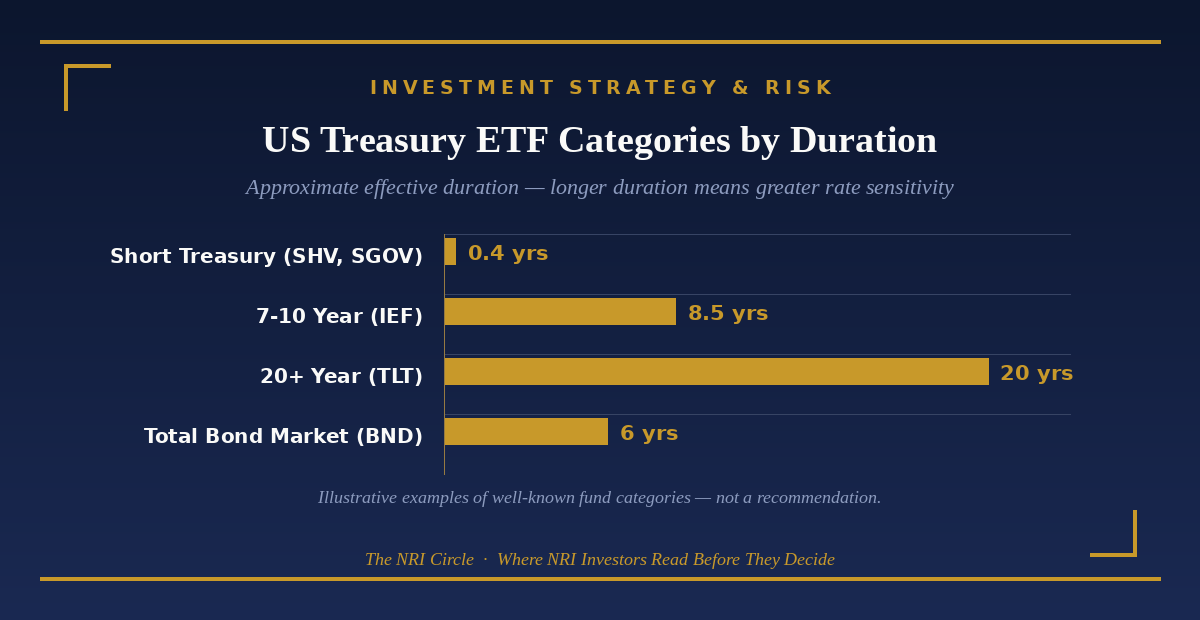
- Treasury ETFs vary widely by duration — short-duration funds behave like a cash equivalent, while long-duration funds carry meaningful interest-rate risk.
- “Government-backed” refers to credit risk, not price risk — Treasury ETF prices still move with interest rates and can decline in value.
This article explains general categories of investment products and how NRIs typically access them. It is educational information only, not investment, tax, or legal advice, and not a recommendation to buy any specific security.
Why US Treasuries Appeal to NRIs Right Now
Three things make them attractive to an NRI audience specifically: they’re denominated in US dollars (useful if your income and future expenses are also in USD, GBP, AED, or another foreign currency), they’re backed by the full faith and credit of the US government, and current yields are meaningfully higher than they were for most of the last decade — short-term Treasury yields have recently been in the 4.5%–5% range, with 10-year yields around 4.2%–4.6%. These figures move constantly with rate policy, so treat them as a snapshot, not a promise, and check current rates before acting.
Can You Buy US Treasury Bonds Directly?
Not in the way most retail investors imagine. Individual US Treasury securities are typically bought at auction or through a US brokerage account with direct market access — not something most NRIs will set up for this purpose alone. In practice, the overwhelmingly common route for retail exposure, NRI or otherwise, is a Treasury ETF: a fund that holds a basket of Treasury securities and trades on a stock exchange like any other listed security.
The Route Most Guides Get Wrong: NRIs Don’t Need LRS
The Liberalised Remittance Scheme lets resident Indians remit up to USD 250,000 a year abroad for permitted purposes, including investing — and most online guides to “investing in US bonds from India” are written around that route, TCS included.
NRIs are a different case. LRS is not applicable to NRIs, because it governs outward remittance from India by residents. If you’re funding a US brokerage account from money that’s already abroad — a foreign salary account, an NRE account, or an FCNR deposit — you are generally not operating under LRS or its caps at all. If you do need to move money out of an NRO account (income earned in India), that follows its own separate repatriation rules, typically up to USD 1 million per financial year, with its own documentation (Form 15CA/15CB and bank compliance). This is a genuinely nuanced area of foreign exchange regulation, so it’s worth confirming your specific route with your bank or a tax advisor before moving large sums.
Three Practical Ways NRIs Access US Treasury Exposure
- An international brokerage account. Platforms that serve NRIs and international investors (some India-focused global-investing platforms, as well as international brokers that accept NRI accounts) let you buy US-listed Treasury ETFs directly using funds already held abroad.
- A US-based brokerage account. Some NRIs, particularly those with an existing US financial footprint (a former US address, an SSN or ITIN, or family in the US), open an account with a US broker directly.
- Indian mutual funds with global debt exposure. A small number of Indian mutual funds offer feeder structures into global or US-focused bond funds, giving rupee-denominated, SEBI-regulated exposure without opening a foreign brokerage account — though with less precision than buying a specific Treasury ETF, and subject to their own expense ratios and tracking differences.
Curious how this applies to your situation? Ask us — it's free →
Common US Treasury ETFs to Know
Continue reading
Get the complete cross-border research note.
Unlock the remaining analysis, risk considerations and official-source references. Enter your name and email for immediate access. WhatsApp and country are optional; newsletter consent is separate and optional.
Official sources and the full research note are available after access is granted.