Start here
The research question behind this note.
A lot of “gold investment options for NRIs” content still leads with Sovereign Gold Bonds — and that’s a problem, because SGBs are no longer being issued, and NRIs were never allowed to buy them in the first place. If you’re researching gold as an NRI…

A lot of “gold investment options for NRIs” content still leads with Sovereign Gold Bonds — and that’s a problem, because SGBs are no longer being issued, and NRIs were never allowed to buy them in the first place. If you’re researching gold as an NRI in 2026, it’s worth starting from what’s actually available today, not what used to be recommended.
The good news: gold exposure is still very much accessible to NRIs — just through a narrower, more specific set of routes than the general “gold investment” content usually assumes.
Key Takeaways
- Sovereign Gold Bonds were discontinued after Budget 2025, and NRIs were never eligible to purchase them under FEMA rules even when they were available.
- Gold ETFs are generally the most practical, liquid, and repatriable route for NRIs seeking gold exposure today.
- Gold mutual funds (funds of funds investing in gold ETFs) offer a similar exposure without needing a demat account.
- Physical gold and jewelry carry storage, security, and import duty considerations that paper/digital gold avoids.
- If you already hold SGBs from your resident days, you can typically continue holding them to maturity — you generally don’t need to force an early exit just because your status changed.
This article explains general categories of gold-related investment products. It is educational information only, not investment advice or a recommendation to buy any specific product.
The Correction Most Articles Miss: SGBs Are Off the Table
Sovereign Gold Bonds were a popular way for resident Indians to get gold exposure with a small added interest coupon — but after Budget 2025, the government discontinued new SGB issuance, largely due to the rising cost of the interest obligation as gold prices climbed. No new tranches have been announced since. Separately, and often missed in older content, NRIs were never permitted to invest in SGBs at all under RBI’s FEMA rules, even back when they were being issued. So for NRIs specifically, this option isn’t a recent loss — it was never on the table to begin with, and now it isn’t on the table for anyone.
What NRIs Can Actually Invest In
With SGBs out of the picture, here’s what NRIs are realistically choosing between:
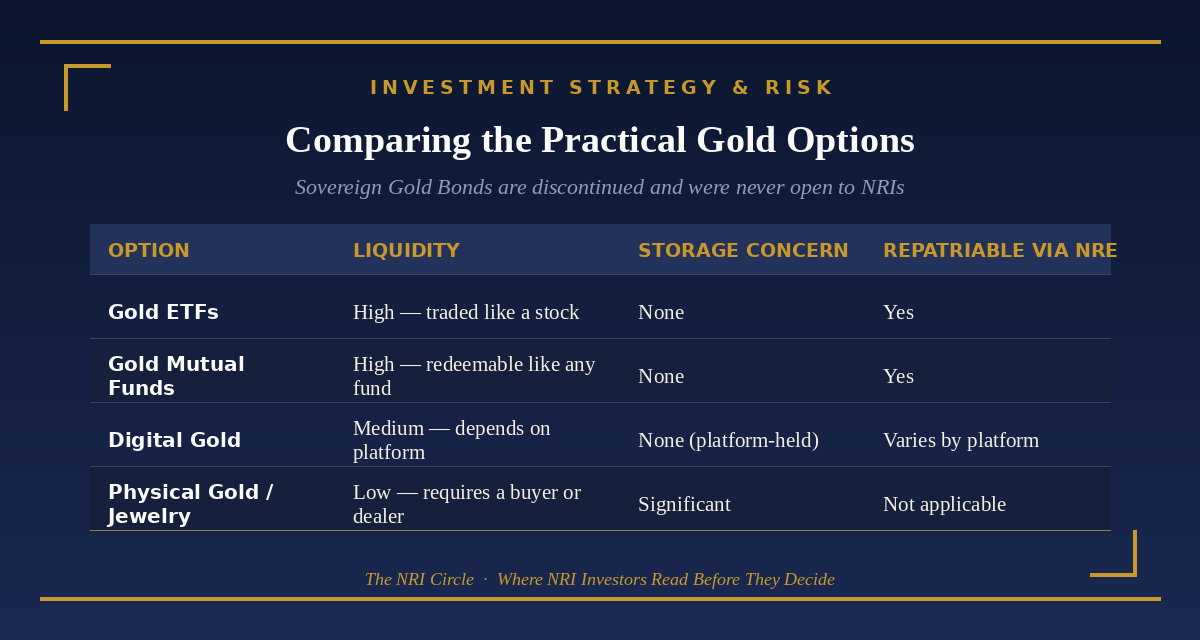
- Gold ETFs. Exchange-traded funds backed by physical gold held in secure, audited vaults, tradable through a regular demat and trading account. Widely considered the most practical route for NRIs — liquid, transparent pricing, and repatriable through an NRE-linked account.
- Gold mutual funds. Funds that invest in gold ETFs on your behalf, bought and sold like a regular mutual fund without needing a demat account — useful for NRIs who don’t already have Indian trading accounts set up.
- Digital gold. Platform-based gold purchases where a provider holds physical gold in your name and lets you buy or sell in small amounts. Convenient, but check the platform’s regulatory status and storage/insurance arrangements carefully, since digital gold in India sits in a comparatively less regulated space than ETFs or mutual funds.
- Physical gold and jewelry. Still an option, but comes with real friction for NRIs specifically: storage and security concerns, import duty considerations if bringing gold into India, and making charges that don’t add investment value.
- International gold ETFs. For NRIs who prefer USD or other foreign-currency exposure, gold ETFs listed on foreign exchanges are accessible through an international brokerage account, entirely separate from India’s gold ecosystem.
Comparing the Practical Options
Curious how this applies to your situation? Ask us — it's free →
What About Existing SGBs You Bought Before Becoming an NRI?
If you purchased SGBs while you were a resident Indian and have since become an NRI, you generally don’t need to force an early exit. Existing bondholders typically retain the right to hold their SGBs through the full original tenure, and can generally still use the early redemption window that opens after five years if they choose to. What you can’t do as an NRI is buy new SGBs — but holding onto ones you already own is usually a separate question.
How Much Gold Should Be in an NRI Portfolio?
Continue reading
Get the complete cross-border research note.
Unlock the remaining analysis, risk considerations and official-source references. Enter your name and email for immediate access. WhatsApp and country are optional; newsletter consent is separate and optional.
Official sources and the full research note are available after access is granted.