Start here
The research question behind this note.
Most investment strategies try to predict where markets are headed. Volatility-controlled strategies do something different — they don’t try to predict direction at all. Instead, they watch how choppy the market has recently been, and adjust how much risk they’re carrying accordingly. When things get turbulent,…
Most investment strategies try to predict where markets are headed. Volatility-controlled strategies do something different — they don’t try to predict direction at all. Instead, they watch how choppy the market has recently been, and adjust how much risk they’re carrying accordingly. When things get turbulent, they pull back. When things calm down, they lean back in.
It’s a mechanical, rules-based approach to smoothing out the ride — and versions of it show up in more NRI-accessible products than most people realize, from balanced advantage funds to certain structured products and insurance-linked strategies.
Key Takeaways
- Volatility-controlled strategies adjust exposure to risk assets based on recent market volatility, not on return predictions.
- When volatility rises, these strategies typically shift toward cash or lower-risk assets; when volatility falls, they shift back toward growth assets.
- The goal is a steadier, more predictable risk level over time — not necessarily higher returns.
- In India, Balanced Advantage Funds and other Dynamic Asset Allocation Funds are the closest widely available product category using this philosophy.
- The trade-off is that these strategies can lag in a fast, sustained rally, since they typically reduce exposure only after volatility has already picked up.
This article explains a general investment strategy category. It is educational information only, not investment advice or a recommendation to buy any specific product.
What “Volatility Control” Actually Means
Instead of asking “will markets go up or down,” a volatility-controlled strategy asks a narrower, more measurable question: “how much has this investment been moving around lately, and does that match my target risk level?” If actual volatility is running higher than the target, the strategy reduces exposure to volatile assets. If it’s running lower, the strategy can increase exposure. The aim is to keep the portfolio’s risk level roughly constant over time, rather than letting it swing wildly with the market’s mood.
How It Works: Continual Rebalancing Between Risk and Cash
In practice, this usually means a fund or strategy continuously rebalances between a risk asset (typically equity) and a lower-risk holding (typically cash, short-term debt, or derivatives-based hedges). A rising equity market with rising volatility — like a sharp sell-off — triggers a shift toward cash. A calm, steadily rising market allows the strategy to hold more equity. This monitoring and rebalancing usually happens on a regular schedule (daily, weekly, or monthly) rather than constantly, and is typically managed by a dedicated investment team or a systematic, rules-based model.
Why Controlling Volatility Can Improve Risk-Adjusted Returns
This connects directly to the math of drawdowns: a portfolio that falls 50% needs a 100% gain just to recover, so avoiding deep drawdowns can have an outsized impact on long-term compounding. By trimming exposure specifically when volatility (and often, drawdown risk) is elevated, these strategies aim to reduce the odds of a catastrophic decline — which is part of why research has found that volatility-targeting approaches can, over some periods, deliver equity-like returns with meaningfully lower volatility, and often a higher Sharpe ratio as a result.
An Illustrative Example
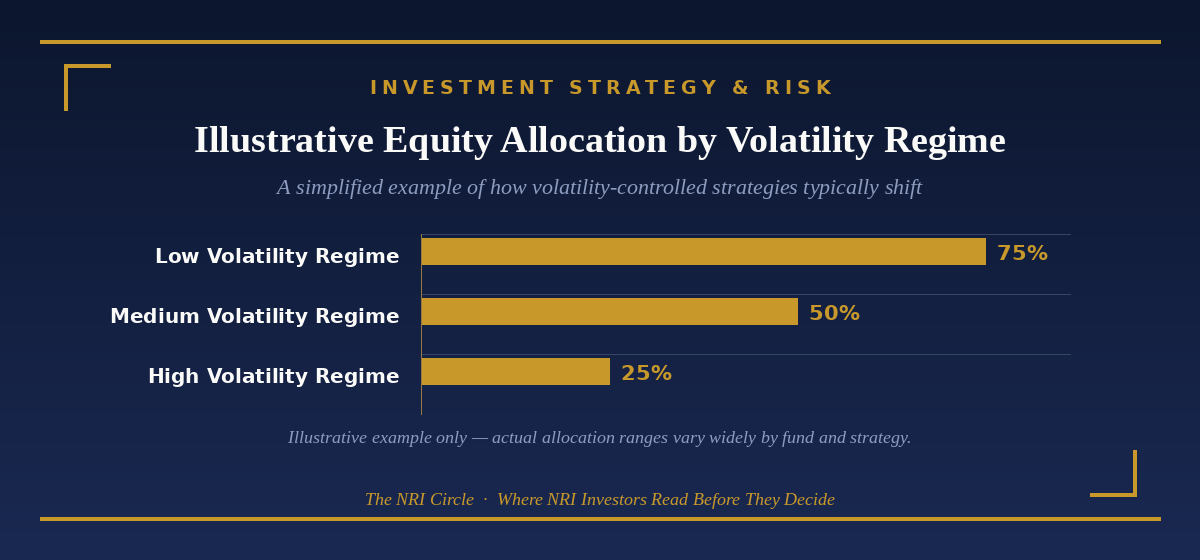
Picture a simplified rule: hold more equity when markets are calm, less when they’re turbulent. In a low-volatility regime, the strategy might sit at a high equity allocation; as volatility climbs into a medium regime, it trims back; in a genuinely turbulent, high-volatility regime, it holds a much smaller equity slice, with the rest parked in cash or short-term debt.
Curious how this applies to your situation? Ask us — it's free →
The Trade-Off: What You Give Up
Continue reading
Get the complete cross-border research note.
Unlock the remaining analysis, risk considerations and official-source references. Enter your name and email for immediate access. WhatsApp and country are optional; newsletter consent is separate and optional.
Official sources and the full research note are available after access is granted.